Age, Juku Culture, And The Heavy Backpack: Why Japan’s School System Stuns Indian Tourists | Education and Career News

Last Updated:
Japan’s disciplined lifestyle and clean surroundings reflect in its unique school system, which often surprises Indian tourists with its order, punctuality, and structure
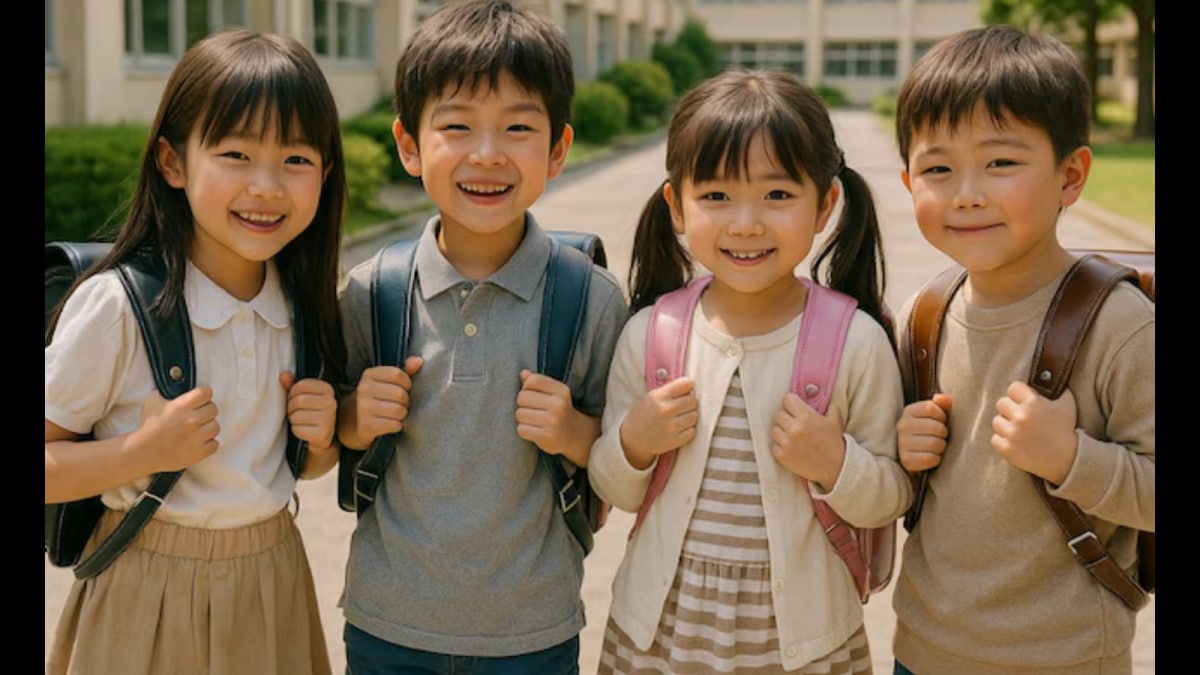
Japan’s education system focuses not only on academics but also on instilling social and moral values. (AI Generated)
Every country has a different education system, with varying admission ages, curricula, and teaching methods. Japan, known globally for its technological progress and disciplined lifestyle, has a unique education model that often surprises Indian tourists visiting the country. The cleanliness, punctuality, and systematic lifestyle observed there also reflect strongly in their schooling practices.
Age-Wise Schooling Model
Compulsory education in Japan begins at the age of six, when children enrol in primary school. The country follows a structured ‘6-3-3-4’ model: six years of primary school (ages 6–12), three years of junior high school (12–15), three years of senior high school (15–18), and four years of university.
Preschool or kindergarten is optional for children aged 3–5. Following the national curriculum issued by the Ministry of Education (MEXT), Japanese schools place strong emphasis on subjects like mathematics, science, and moral education.
Focus on Discipline and Values
Japan’s education system is internationally recognised for its discipline, high standards, and well-structured format. The focus is not only on academics but also on instilling social and moral values. Homework starts from the first grade and remains light in primary school (about 1–2 hours daily). However, the workload increases to 2–3 hours in junior and senior high school. Students are also expected to complete homework during summer holidays. Many students attend ‘Juku’ or cram schools, especially in higher grades, to prepare for competitive entrance exams.
Preschool Learning and Early Development
Children in Japan often enrol in preschool before beginning compulsory schooling. While kindergarten is optional, around 98% of children attend it, according to MEXT. These early years focus on play-based learning, songs, stories, and group activities that help develop social skills and basic literacy. Compulsory education continues till the end of junior high school at age 15.
What Do Students Learn?
At the primary level, students are taught core subjects such as Japanese language, mathematics, science, social studies, music, and art, along with moral education. Junior high school introduces more complex subjects, including English. Most students continue to senior high school, even though it is not mandatory. This stage plays a crucial role in preparing students for university entrance. Higher education typically lasts four years, focusing on specialisation.
Cleanliness and Collective Responsibility
Japanese schools place strong importance on discipline and collective responsibility. Children clean their own classrooms, a practice that reinforces respect, punctuality, and teamwork. The academic year starts in April and ends in March, with breaks in summer, winter, and spring. Schools follow a national curriculum that is academically rigorous and values-driven.
Public and Private School Expenses
Public schooling in Japan is largely free during the compulsory years, though parents are required to pay for additional costs like school lunches (about ¥4,000–¥5,000 per month), books, materials, uniforms, and activities. From 2025, tuition for public senior high schools is expected to be free.
Private schools, however, are significantly more expensive, with fees ranging from ¥900,000 to ¥1.3 million per year, depending on the level and location.
Randoseru: A Symbol of Primary Schooling
Japanese primary students use a traditional leather backpack called a Randoseru, known for its durability. While an empty bag weighs 1–1.5 kg, its total weight with books and other items can rise to 4–6 kg, sometimes even reaching 8 kg. The cost of a new Randoseru starts at around ¥55,000, and can go up to ¥100,000 depending on quality and design. There is growing discussion around adopting digital books and school-based storage to reduce this burden.
- First Published: