CBSE Class 12 Physics Paper Analysis: Students Find Exam Lengthy But Well-Balanced Overall

Last Updated:
CBSE Board Exam 2025: CBSE Class 12 Physics board exam begins today from 10:30 am to 1:30 pm. Check marking scheme and other details.
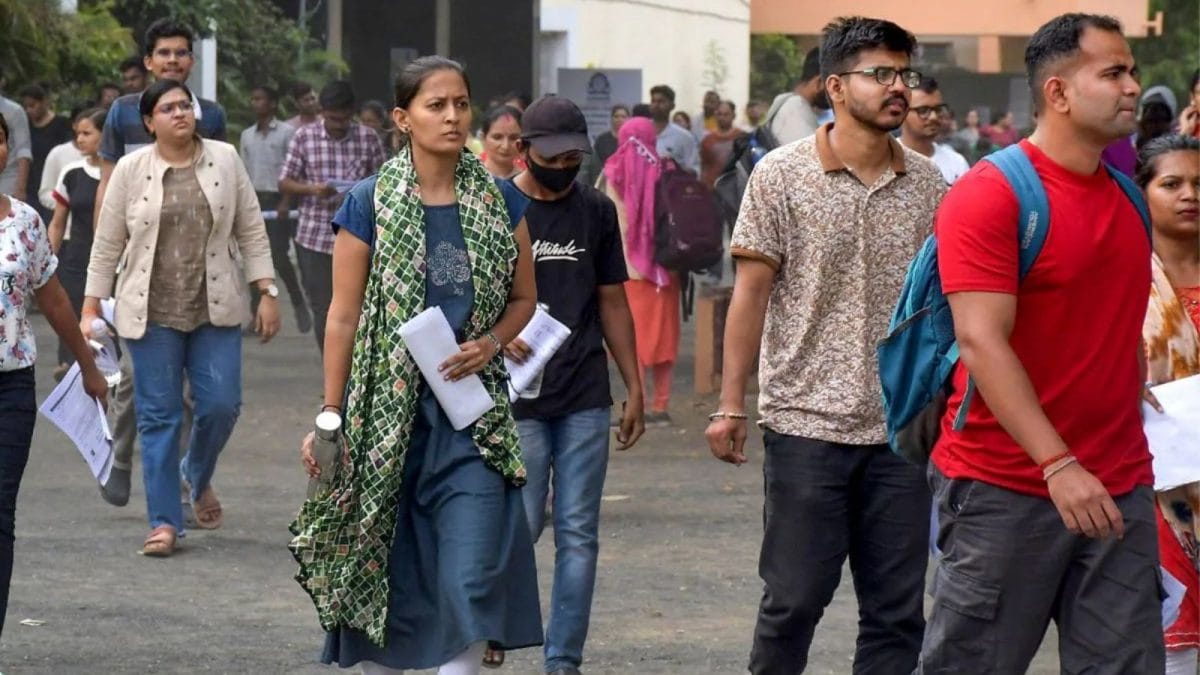
Check CBSE Class 12 Physics paper marking scheme, paper analysis. (Representative Image/AFP)
CBSE Class 12 Physics Paper Analysis: The Central Board of Secondary Education (CBSE) will hold the Class 12 Physics board exam today. The exam will take place from 10:30 am to 1:30 pm, and students will get 15 minutes to read the question paper before starting. The Physics paper will have five sections—A, B, C, D, and E—with a total of 33 questions. Students must attempt all questions.
CBSE began the Class 12 board exams on February 15 and has already conducted five papers, including Entrepreneurship, Physical Education, Hindustani Music (Vocal and Instrumental), Automotive, Healthcare, Data Science, Electronics, Food Production, Office Procedures, Design, Early Childhood Care, and Typography & Computer Applications.
Students must carry their CBSE Class 12 admit card and school ID to the exam centre. The board issued the admit cards on February 3.
Students can find the CBSE Class 12 Physics paper analysis in this story after the exam concludes.
CBSE Class 12 Physics Paper Analysis
Students found the CBSE Class 12 Physics paper challenging, with some sets being more concept-heavy and time management proving to be a key factor.
Praneel Munshi, a student from Shiv Nadar School, Noida, said, “The paper was well-balanced overall, though Set 3 was particularly concept-heavy. Managing time effectively was a challenge, as the depth of questions required thorough reasoning and application.”
Another student, Shivam Kole, shared his experience: “The paper was lengthy and highly challenging, demanding both strong conceptual understanding and practical application. Surprisingly, the expected questions from Optics were absent, adding an unexpected twist to the assessment.”
CBSE Class 12 Physics Paper Marking Scheme
The CBSE Class 12 Physics exam follows a specific marking scheme with different sections:
- Section A: 16 questions, including 12 multiple-choice questions (MCQs) and 4 assertion-reasoning questions, each carrying 1 mark. (16 marks)
- Section B: 5 questions, each worth 2 marks. (10 marks)
- Section C: 7 questions, each carrying 3 marks. (21 marks)
- Section D: 2 case study-based questions, each worth 4 marks. (8 marks)
- Section E: 3 long-answer questions, each carrying 5 marks. (15 marks)
The total marks for the exam are 70.
CBSE Class 12 Physics Paper Unit Wise Marking Scheme
The CBSE Class 12 Physics paper is divided into different units, each carrying specific marks:
Unit I: Electrostatics
- Electric Charges and Fields
- Electrostatic Potential and Capacitance
Unit II: Current Electricity
Total 16 Marks for units 1 and 2
Unit III: Magnetic Effects of Current and Magnetism
- Moving Charges and Magnetism
- Magnetism and Matter
Unit IV: Electromagnetic Induction and Alternating Currents
- Electromagnetic Induction
- Alternating Current
Total 17 Marks for units 3 and 4
Unit V: Electromagnetic Waves – 18 marks
Unit VI: Optics
- Ray Optics and Optical Instruments
- Wave Optics
Total 18 Marks for units 5 and 6
Unit VII: Dual Nature of Radiation and Matter
- Dual Nature of Radiation and Matter
Unit VIII: Atoms and Nuclei
Total 12 Marks for units 7 and 8
Unit IX: Electronic Devices
- Semiconductor Electronics: Materials, Devices, and Simple Circuits
7 Marks for unit 9
The theory paper is worth 70 marks, while the practicals are worth 30 marks, for a total of 100 marks.